NGOs and civil society
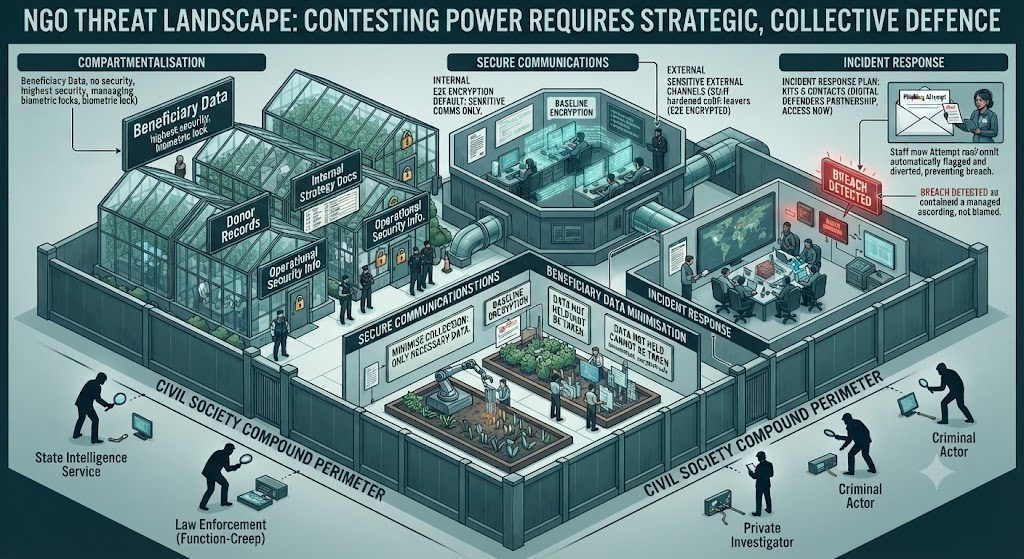
An organisation that contests power inherits the adversaries of the powerful. The assets at risk are not only organisational data; they are the people in the network, the individuals who shared information, sought support, or took part in activities that could expose them to retaliation. A breach that exposes a beneficiary list is not a data governance failure. It is a harm to real people who trusted the organisation with their safety.
The organisation is also the route to them. An adversary who cannot reach an activist directly may reach them through the organisations they deal with, often not through a technical exploit but through a staff member who opens a convincing message appearing to come from a partner, a funder, or a journalist. Capacity is constrained as well: most civil society organisations run on budgets that do not stretch to a security team, so guidance written for a well-resourced company does not transfer. That is not a gap to apologise for. It is a constraint to design around.
From concern to action
Concern |
What can help |
|---|---|
A beneficiary or donor list becoming a harm to the people who trusted the organisation |
Minimise what is collected, keep names separate from the data, audit what is held |
Internal or external communications read by an adversary |
|
Devices searched or seized crossing into a hostile jurisdiction |
|
A staff device suspected of being monitored |
PiRogue and Wazuh, a spare Android as a traffic monitor, DNS-level detection, suspected device compromise |
A supplier or platform the organisation depends on becoming the way in |
|
A legal or state demand for the data held |
|
A breach exposing what the organisation holds |
|
A staff member or someone in the network doxxed |
|
Data encrypted now, read once the cryptography breaks |
Culture under pressure
Organisations that work in difficult contexts often develop security cultures that are either overly informal (we trust each other, we do not need formal controls) or overly anxious (every conversation is a potential leak). Neither is accurate, and both produce bad outcomes.
The informal model underestimates how often targeted attacks come through trusted channels. The adversary does not usually announce themselves. The anxious model makes communication harder and can suppress the honesty and information flow that effective organisations depend on.
People under stress communicate differently, and security cultures feel this before incident logs do. When staff feel that a security conversation will result in blame or burden, they will manage disclosures carefully. Near-misses will not be reported. Incidents will be minimised. The security culture will become incongruent with the actual state of the organisation.
Building a culture where security incidents are reported without fear requires that reporting be experienced as useful rather than punishing. Respond to disclosures with problem-solving, not interrogation. Treat someone who reports a phishing click as someone who helped you find a gap.
The structural conditions
Civil society organisations are targeted partly because they contest power. The same political conditions that make their work necessary also make them adversarial targets for actors with resources and institutional access that most NGOs cannot match.
This is not defeatism. It is a calibration. The goal is raising the cost and complexity of surveillance sufficiently that casual or speculative targeting becomes less rewarding, and that if targeted attacks do occur, the damage is contained.
Solidarity between organisations is what does the work here. Shared threat intelligence, shared incident response resources, and mutual support when an organisation is under attack are structural defences against adversaries who benefit from civil society operating in isolation. Digital Defenders Partnership, Access Now’s Digital Security Helpline, and Front Line Defenders all support organisations facing active threats.
The power asymmetry between the organisations described in the surveillance threat model and most NGOs is real. Accepting that asymmetry as fixed is not required. Collective action at regulatory and legislative level has reshaped data protection law before. That work continues.
Last reviewed: 2026-07-09.